Toc H Queensland History Our Motto
Our Motto

Service is the rent we pay
for our room on Earth.

The motto of Toc H — and the story of where it really comes from.

This phrase is widely attributed to Muhammad Ali, Shirley Chisholm, and several others including Wilfred Grenfell, Marian Wright Edelman, and Nathan Eldon Tanner . The evidence tells a different story. It was written by the founder of Toc H and published in The Times, London, on 15 December 1923 — decades before any other known attribution.

"Service is the rent we pay for our room on Earth." For over a century, these words have guided the work of Toc H. They appear in our founding ritual, spoken at initiations across the world. They are not borrowed words. They are ours.

The phrase was written by the Rev. P. B. "Tubby" Clayton — priest, padre, and founder of Toc H — and published in The Times, London, on Saturday 15 December 1923, the 8th anniversary of Talbot House. Tubby named the article after the phrase itself: Our Room on Earth.

There is a quiet piece of Queensland in this story. Tubby Clayton was born in Maryborough, and the first Australian reprint of that Times article appeared in the Maryborough Chronicle on 6 March 1924 — a hometown paper honouring a hometown son. Within two years the words had been documented across Australasia, from Sydney and Melbourne to Brisbane and as far as Port Moresby.

By December 1923, the ritual was already established in fifty towns and cities — Tubby's own words in the article. As far as current research shows, this is the earliest known printed record of the phrase. These words had been spoken long before they were written down.

At every Toc H initiation, the same exchange was spoken — published by Tubby Clayton in The Times, London, 15 December 1923.

What lit this lamp?
Unselfish sacrifice.
What alone can maintain it?
Unselfish service.
What is service?
The rent we pay for our room on earth.

These words formed the heart of the Toc H initiation ceremony from the movement's earliest days — a promise made by every new member, in every town and city where Toc H took root.

There is something uniquely powerful about words forged in the shadow of the Western Front — spoken by men who knew the cost of service firsthand, in a candlelit room in Poperinghe, in a house named after a fallen friend. The past tense does not diminish them. It locates them in their moment. And that moment gives these words a gravity that no present-tense claim can match.

Tubby Clayton's article, Our Room on Earth

The complete article as published across pages 13–14 of The Times, Saturday 15 December 1923, presented in six sections. Accessed via the State Library of Queensland's Times Digital Archive subscription.

Original masthead The Times, London — Saturday 15 December 1923 — No. 43,525
The Times, London — Saturday 15 December 1923 — masthead and front matter
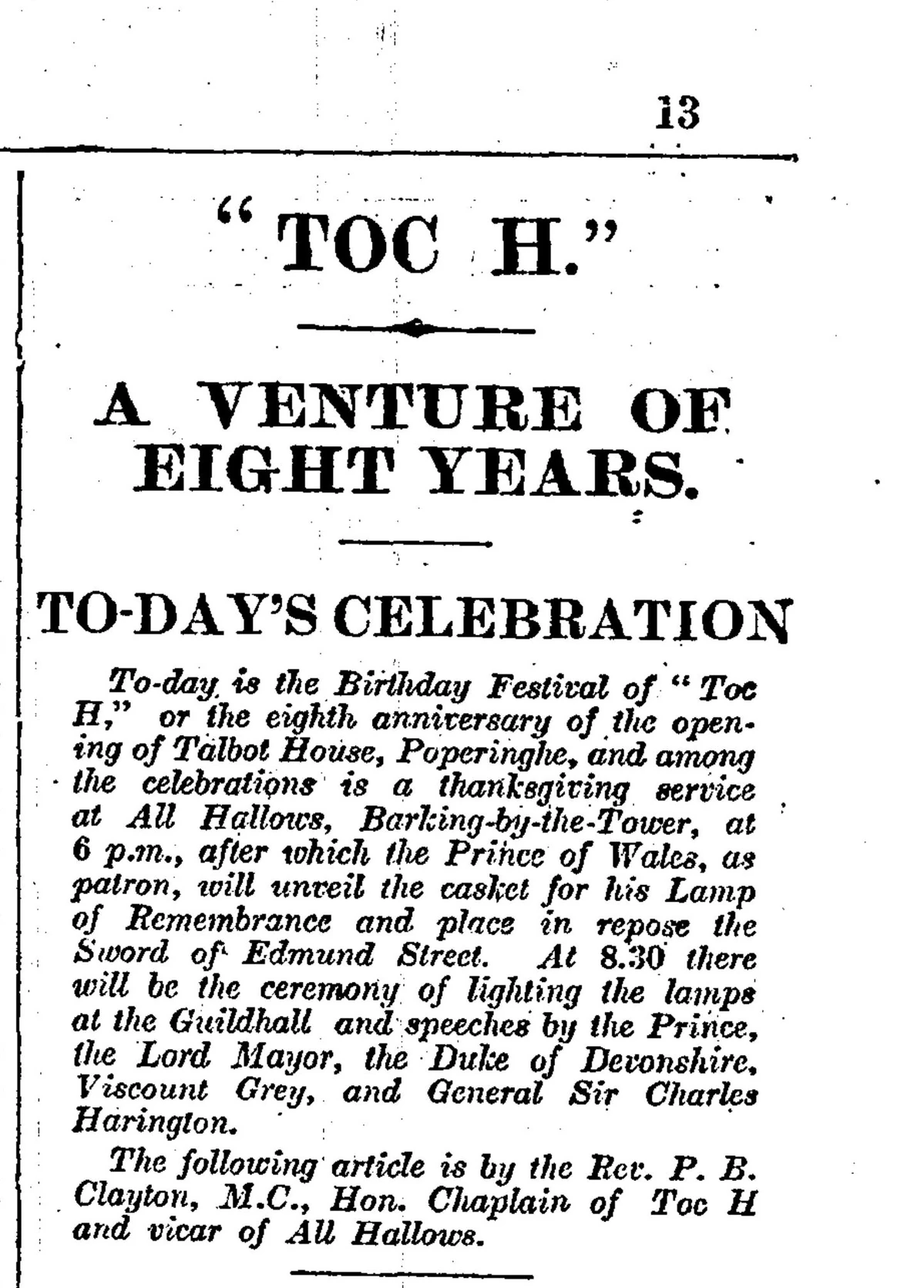
Newspaper page 13, The Times, London, 15 December 1923 — 'TOC H. A Venture of Eight Years' — article heading and 8th anniversary celebration notice
Page 13 — "TOC H. A Venture of Eight Years" — the article heading and 8th anniversary celebration notice
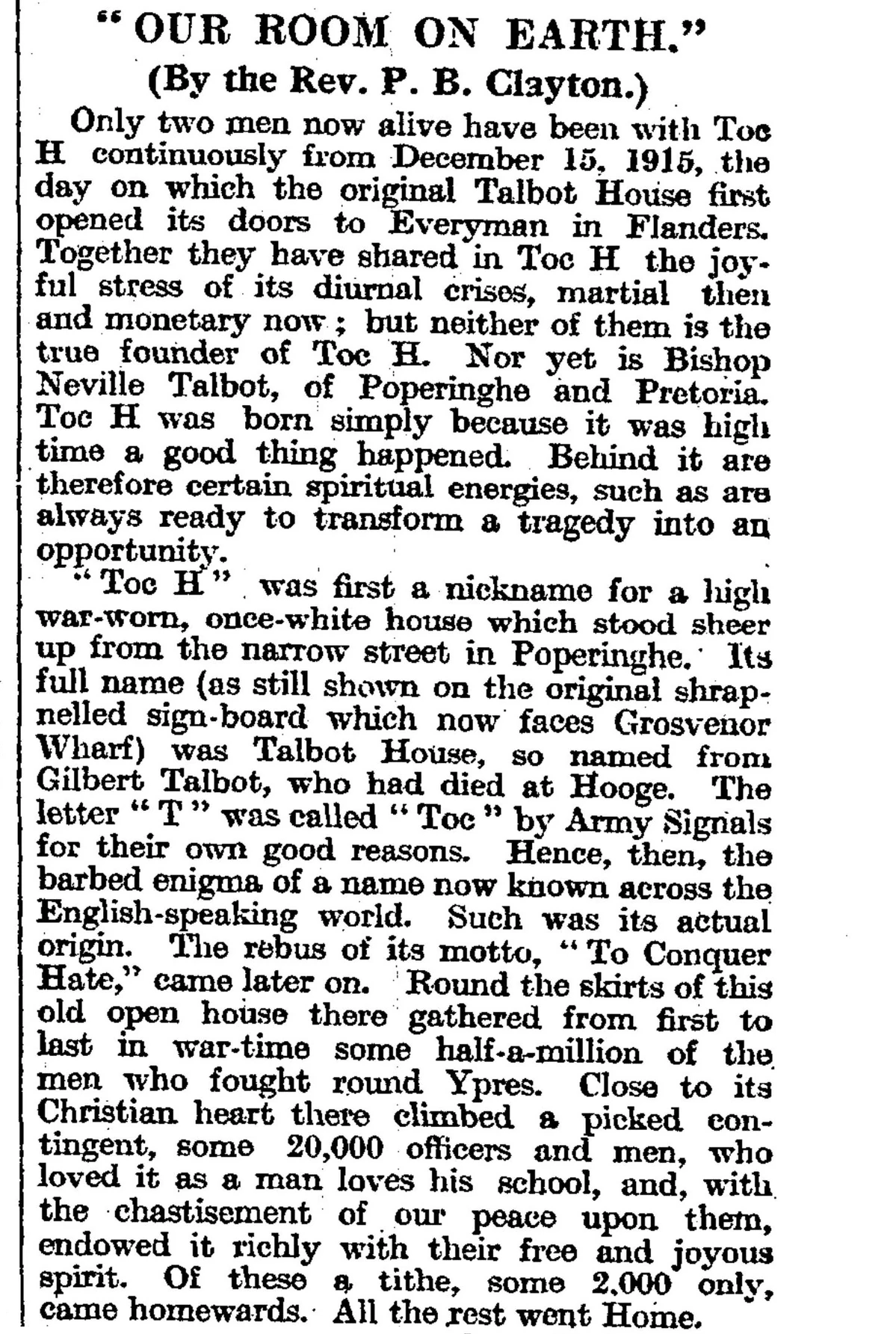
Tubby Clayton's essay 'Our Room on Earth' opens — the origin of Talbot House, the name Toc H, and the half-million men who passed through Ypres
The essay opens — the origin of Talbot House, the name Toc H, and the half-million men who passed through Ypres
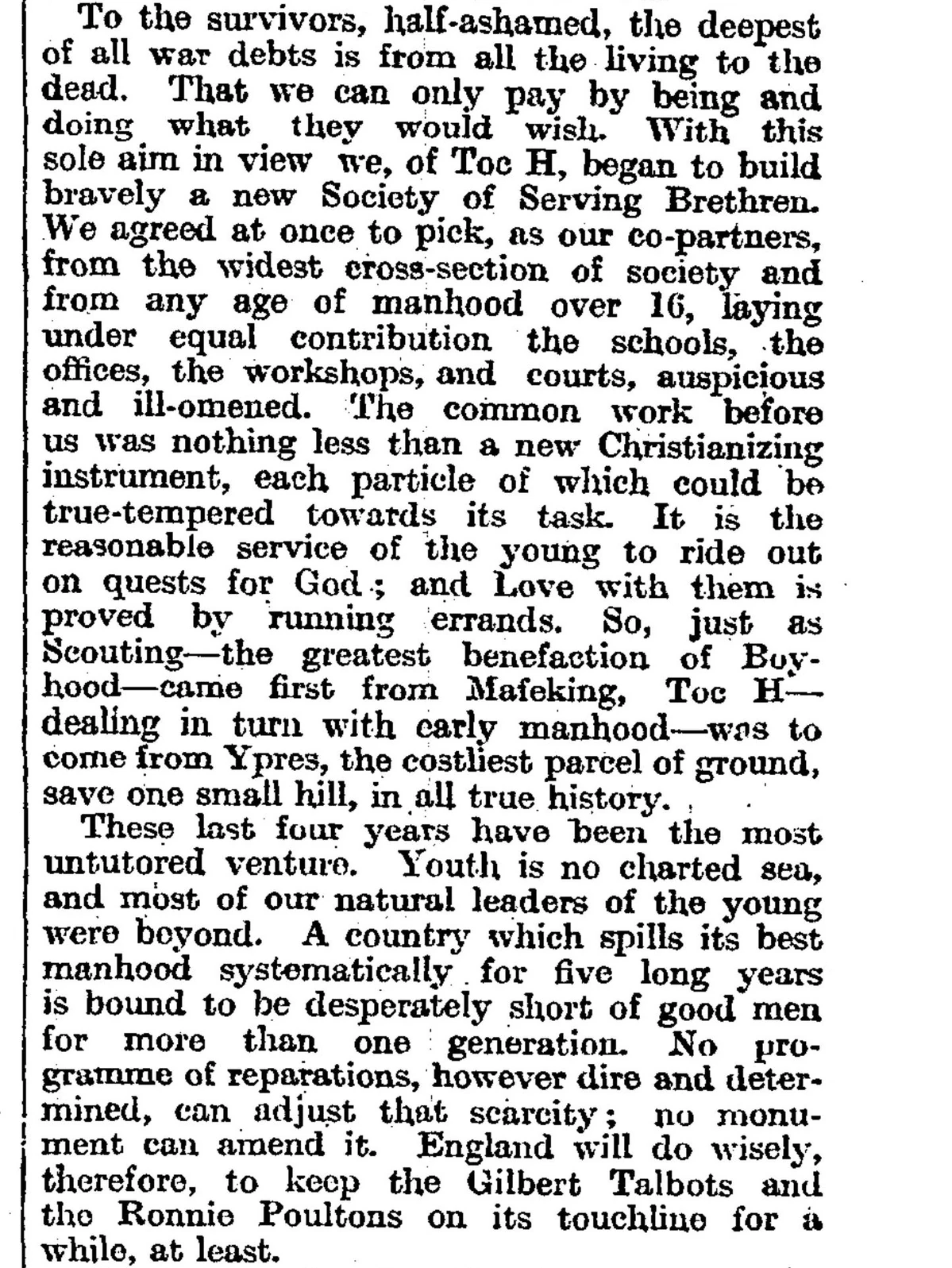
Tubby Clayton on the debt to the fallen — the Society of Serving Brethren, and Toc H following Scouting from the costliest ground in history
The debt to the fallen — the Society of Serving Brethren, and Toc H following Scouting from the costliest ground in history
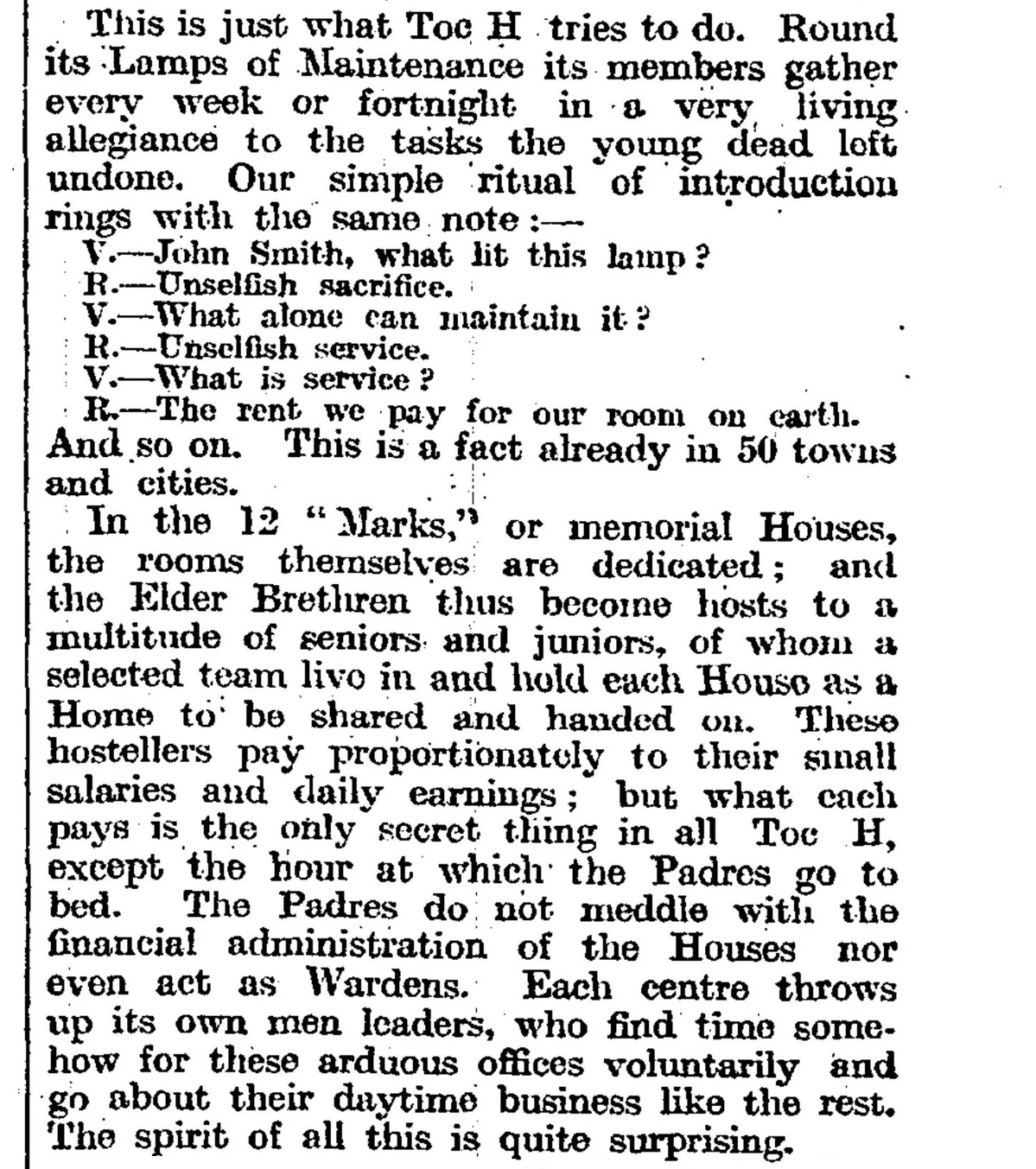
The Toc H initiation ritual as published in The Times, 1923 — including 'R.—The rent we pay for our room on earth.' — already in use in 50 towns and cities
The initiation ritual in full — "The rent we pay for our room on earth." Already in use in 50 towns and cities.
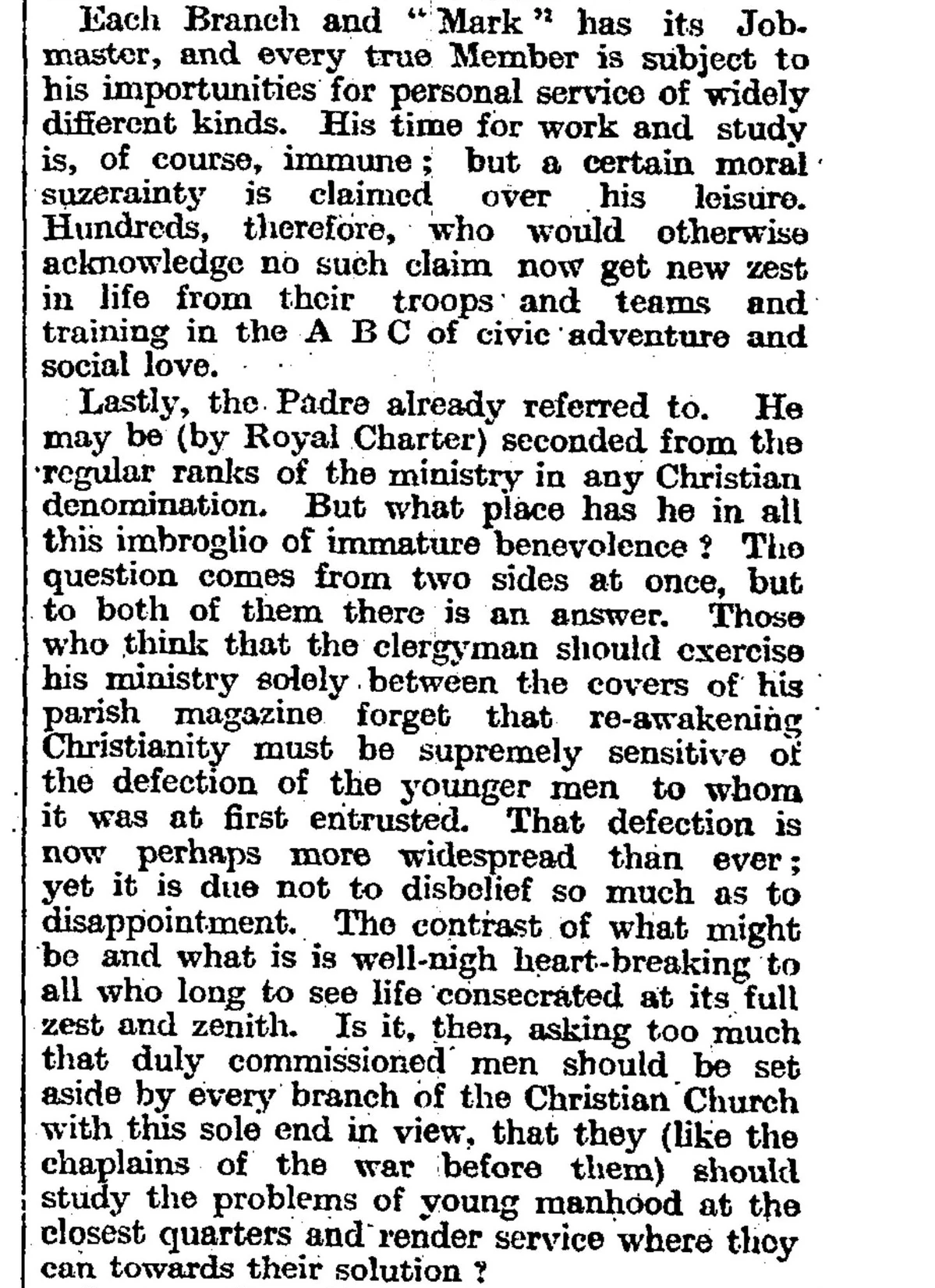
The Jobmaster structure and the role of the Padre in Toc H — the two sides of the question of service and ministry
The Jobmaster and the Padre — the two sides of service and ministry
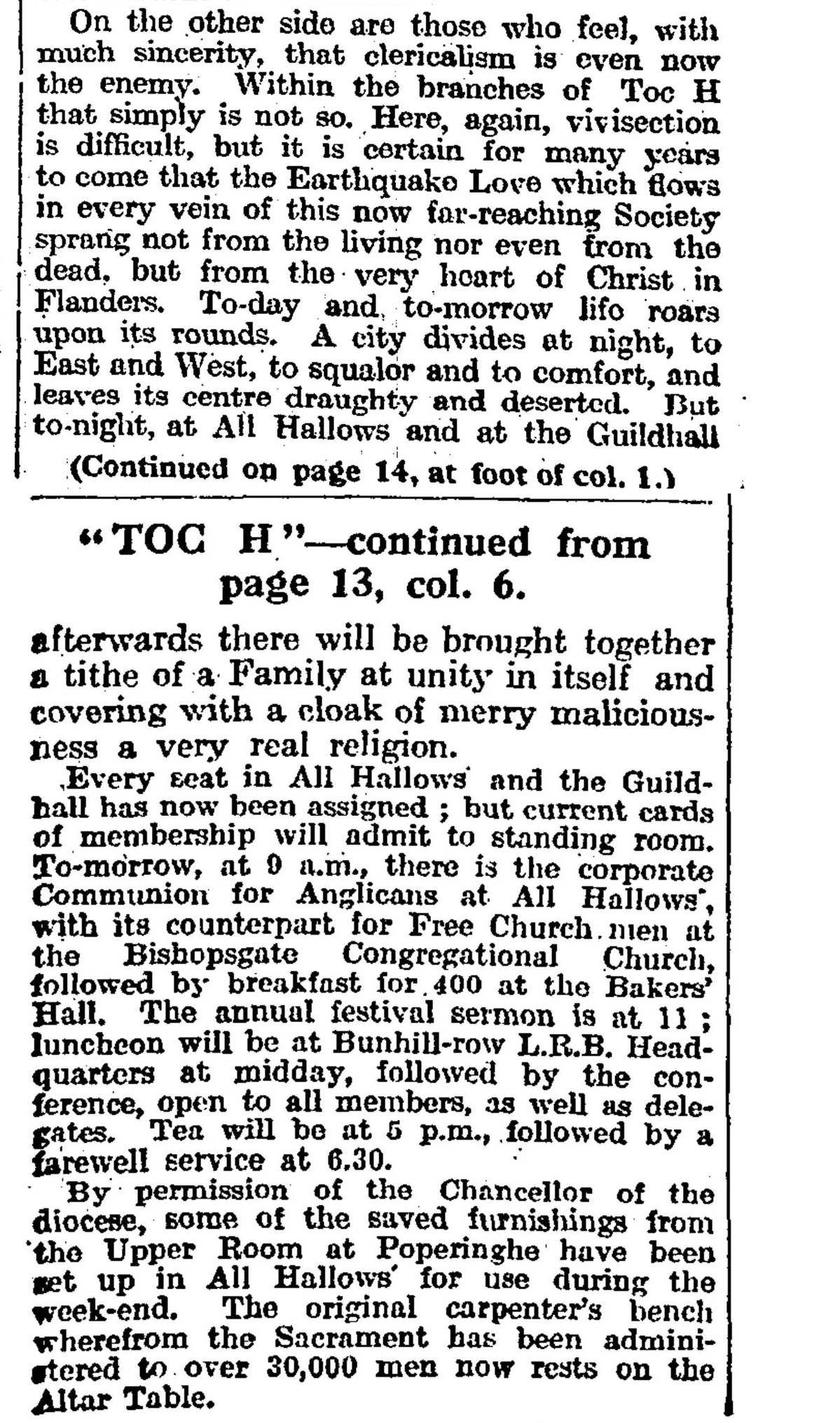
The conclusion of Tubby Clayton's article and the page 14 continuation — the 8th anniversary celebrations, and the Upper Room carpenter's bench from Poperinghe
The conclusion and continuation — the 8th anniversary celebrations, and the Upper Room carpenter's bench from Poperinghe

From London to Australasia — the documentary record

From a single article in The Times of London, these words travelled across the world. In Australia alone, at least seventy-three newspaper articles recorded them over the following decades. Here is how the trail begins.

1923 — London
The Times, London — 15 December 1923
Tubby Clayton publishes Our Room on Earth in The Times on the 8th anniversary of Talbot House. The full initiation ritual appears in his own words. Already established in fifty towns and cities.
1924 — Queensland
Maryborough Chronicle — 6 March 1924
The earliest known Australian reprint. Maryborough — the town where Tubby was born — is the first in Australia to carry his words home.
1925 — New South Wales
Sydney Mail — 24 June 1925
Tubby is personally in Sydney conducting initiations. The full three-part ritual is printed in full for Sydney readers.
1925 — Victoria
The Argus, Melbourne — 27 August 1925
A Rotary Club speaker recounts hearing the phrase at a Dunedin meeting in New Zealand. Less than two years after publication, the words had already travelled beyond Toc H into broader civic life.
The Age, Melbourne — 5 September 1925
Tubby conducts initiations personally, Lord Forster lighting the rushlight. Around 150 members present. The full ritual recorded word for word.
1925 — New South Wales
Barrier Miner, Broken Hill — 9 October 1925
Six local candidates initiated in a smoke room, a candle standing in for the lamp. The ritual spoken in one of the most remote cities in Australia.
1926 — Papua New Guinea
Papuan Courier, Port Moresby — 16 July 1926
An article explaining Toc H to Papua New Guinean readers — noting the movement was "originally started by an Australian, the Rev. P. B. Clayton of North Queensland." The words had reached across the Coral Sea.
1927 — Queensland
Brisbane Courier — 18 May 1927
"The slogan of Toc H is 'Service is the rent we pay for our room on earth.'" In Brisbane. In our city.
1927 — Victoria
Glengarry Journal, Traralgon — 4 July 1927
A Baptist pastor preaches Toc H to his congregation in a small country town, hoping to start a local group. By 1927 the phrase had travelled so far from its origin that an ordinary country minister was using it as the centrepiece of a Sunday sermon — not as ritual, but as gospel truth. That is how words become part of a culture.
The trail continues across many more documented articles in the decades that follow.
As of May 2026, at least seventy-three Australian newspaper articles in the National Library of Australia's Trove archive match the search "toc h" "the rent we pay" — sorted oldest first at trove.nla.gov.au

Words that were never meant to stay in one room.

Over the decades, these words found their way into the speeches and writings of remarkable people — among them Muhammad Ali, Shirley Chisholm, Marian Wright Edelman, and others. That so many were drawn to them is no surprise. They are true. They are simple. And they carry the weight of every person who has ever spoken them in a candlelit room and meant it.

These words belong to Toc H. They always have. But words so powerful were never meant to stay in one room — and we are glad they didn't.

Sources

Clayton, Rev. P. B. "Toc H." The Times, 15 December 1923, p. 13. The Times Digital Archive, document CS219354511.

Available via The Times Digital Archive through most Australian state library memberships.

Australian newspaper evidence sourced from Trove, the National Library of Australia's digitised newspaper archive. As of May 2026, at least seventy-three articles match the search "toc h" "the rent we pay" — sorted oldest first.

trove.nla.gov.au/search/category/newspapers?keyword="toc%20h"%20"the%20rent%20we%20pay"&sortBy=dateAsc